
Overcoming the Ice
70th Edition - January 16th, 2026 - Sir Ernest Shackleton, Third Man Syndrome, and moving forward

January has a way of narrowing the world around us. The built-in expected cheeriness of the Holiday season is past. The weather, at least in the Northeast US, shifts vibes quickly from “white Christmas” to “ruining everyone’s plans.” The days are short, the cold settles in like an unwelcome houseguest, and most of us retreat inward without even noticing. This is because, evolutionarily, winter expects us to slow down, to conserve, and to endure. We hunker down not just physically, but emotionally too. Our social calendars thin out, and big plans feel optional. January is definitely not a month of momentum. It’s about getting through the days while waiting for the ground to thaw.
Actually, now that I think about it, this description encapsulates what it has felt like for many of us in the US for all of the last year. Enduring. Hunkering down. Just getting through it. But I digress…
For me, someone who leans hard toward anxious rumination, it’s hard not to notice how closely all of this mirrors the broader moment we’re living in. There’s an undeniable a heaviness right now that goes beyond weather. It’s political tension leading to relational fracture here at home and with our neighbors and allies abroad. Conversations feel sharper and cut deeper. Grace is elusive (and harder to offer, if I’m being honest). We’re quicker to assume the worst of one another, quicker to retreat into our collective corners. It’s a season where we’re all carrying a low-grade exhaustion that (probably) doesn’t have a single source, but still weighs us down all the same.1
Winter in Upstate New York strips things bare. It removes the illusion that everything’s fine because we’re busy. It forces honesty about questions we like to push to the back burner: Who steadies you when the days feel long? What helps you keep moving when everything is at a standstill. Who walks alongside you when the path forward isn’t clear, not necessarily to fix it, but to help you stay oriented within it?
When I find myself circling those questions, I usually end up thinking about people who’ve endured real darkness and true uncertainty; People who were cut off from rescue, from reassurance, from any guarantee that things would turn out okay because they reveal what we humans reach for when survival becomes the only goal.
And that’s how the Universe brought me to Ernest Shackleton.
Grit, Survival, and The Third Man
In 1914, Sir Ernest Shackleton and a twenty-seven man crew set out from South Georgia Island far off the south eastern tip of Argentina on his ship, the Endurance, hoping to make the first land crossing of Antarctica. This was an undertaking not truly seen since the so-called Age of Discovery in the 15th - 17th centuries. Shackleton’s plan was definitely bold, questionably arrogant, and seemingly typical of his documented belief that human grit could overcome all, even the unpredictable power of nature.
Nature, it seems, felt differently.
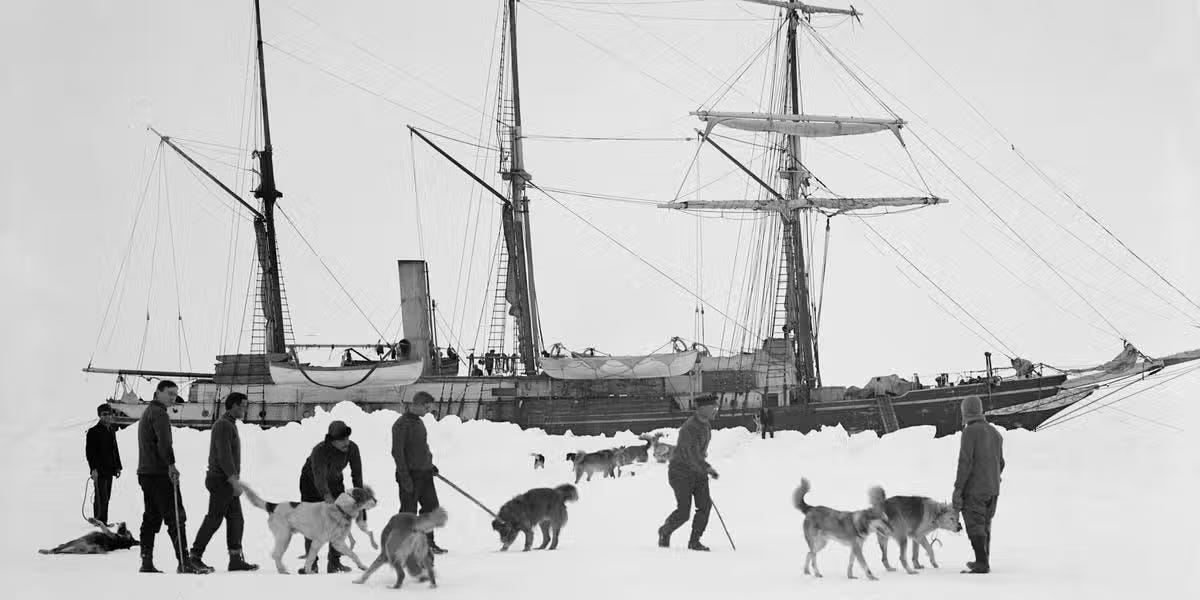
Before the crew even reached the Antarctic continent, in January of 1915, the Endurance became hopelessly trapped in pack ice in the Weddell Sea. At first the men, encouraged by their leader, took on a light-hearted joking approach to their situation, posing for photos with their ship imprisoned behind them and even played soccer and hockey on the frozen surface. That optimism, however, was short lived as the ice tightened around them slowly crushing the hull plank by plank until the Endurance finally sank. They were stranded on drifting floes with no shelter beyond the what they could build with the materials rescued from the ship and radical hope.
For nearly two years, Shackleton led his men through conditions that truly defy imagination. They ate whatever moved. They slept on ice that cracked and shifted beneath them at night. They watched their maps become useless as the currents pulled them hundreds of miles off course. Eventually, in an act of desperation, Shackleton took five men into a 20-foot lifeboat and crossed 800 miles of the roughest ocean on Earth, the Drake Passage, to reach South Georgia Island off of the coast of South America. From there, he selected two companions to attempt a land crossing across mountains no one had ever charted.
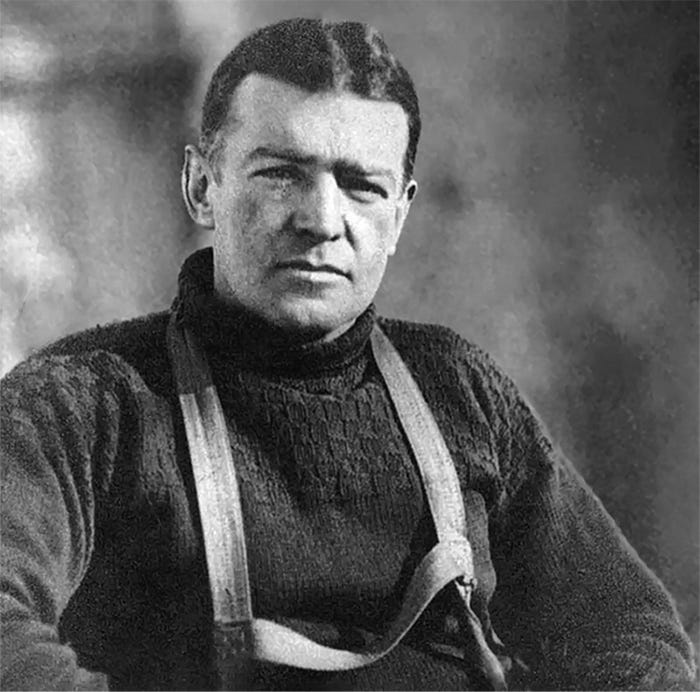
It was during that final slog with wind slicing at their faces, feet bleeding through their boots, and bodies whittled down to bone that Shackleton began to feel something…odd. Later he would describe it as a steady, invisible presence that seemed to be walking alongside him. He wrote that he felt guided by someone who created no sound yet made what should have been an unendurable trip endurable. Much to his surprise, his two companions reported the same thing, independently, without knowing the others had felt it.
That small mystery in the middle of a frozen landscape became one of the most compelling illustrations of what science now calls Third Man Syndrome, purported to be the mind’s ability to summon an unseen companion when a path is simply too hard to walk alone. Researchers have spent decades poking at this idea2, trying to determine why humans in extreme conditions may summon this alleged companion. Most explanations of the phenomenon focus on brain and nervous system failsafes meant to protect our body and mind from falling apart in extreme, sensory deprived, neurologically unsafe situations. There are other explanations, too, but it seems that everyone agrees on one point. Human beings are not built to endure hardship alone. Even the brain does whatever it must to bring in backup.
Stepping Into a Brave New Year
Most of us aren’t crossing Antarctica, but this past year certainly had its own treacherous landscapes to overcome. Many have been and continue to be relentlessly steep, physically dangerous, and emotionally slippery. Modern life can feel like constantly living in very thin air. Yet for me, in nearly every hard personal moment, someone has appeared beside me. Friends, family, colleagues, even my dogs. They were a presence that steadied the ground under my feet, knowing inherently when I needed them.
Shackleton never completed the journey he set out to make, but every one of his men survived. That didn’t happen because of luck. It happened because, in moments when fear and exhaustion, when ice could have splintered more than his ship, he refused to let anyone face the worst of it alone. His crew later said they felt safer simply because he was present. Talk about powerful.
There’s no doubt about it. We’re living in a moment that is politically unsafe, emotionally charged, ethically challenged, and increasingly hostile to empathy. Conflict is rewarded because outrage is monetized. Dehumanization is casual, almost recreational, for a certain subset of society. People are encouraged to pick sides, harden their edges, and treat one another as problems to be solved or opponents to be defeated rather than humans to be understood. The air is thin for a lot of people, especially those already carrying grief, fear, marginalization, or all of the above.
In conditions like that, it’s tempting to retreat and convince ourselves that being kind is naive or that remaining calm is the same as being passive. It isn’t. The science behind Third Man Syndrome tells us something essential about who we are. When circumstances become overwhelming, the human mind reaches for companionship. If none is available, it creates it. We’re not built to endure hardship alone. Even our brains rebel against that idea.
What next?
So the question in front of us as we step into 2026 isn’t how to be tougher or more dominant or more certain. I think it’s how to be confident on our own two feet while acting as the kind of individual who lowers the temperature instead of raises it. As leaders, that means choosing humanity over performance and slowing down enough to truly listen. It means protecting dignity, especially when it’s inconvenient or unpopular. In our personal lives, it looks like turning toward one another when everything in the culture tells us to retreat, ridicule, or write people off.
This isn’t about being “nice.” It’s about choosing decency in a moment that increasingly rewards cruelty, and recognizing that showing up with empathy and courage is, in fact, an act of resistance. We can’t fix everything, but we can be the one who offers an arm when someone stumbles. We can help each other stay oriented when the path forward isn’t clear. We can choose, again and again, to walk each other home.3
Shackleton’s men survived because someone stayed with them when it mattered most. Their truth is a universal one. We’re better together. Let’s make 2026 the year we stop pretending otherwise.


If you liked this post, then you may want to check out….


If you aren’t walking around frustrated and exhausted every single day right now, please share your secrets with me ASAP.
See: Blanke, O., et al. “Presence hallucinations: A systematic review.” Neuroscience & Biobehavioral Reviews, 2023. Available via PubMed Central: https://pmc.ncbi.nlm.nih.gov/articles/PMC10436335/, A Case of Third Person Experience at High Altitude, Psychiatry Research Case Reports, 2023. PubMed ID: 37620238. https://pubmed.ncbi.nlm.nih.gov/37620238/, and EBSCO Research Starters, “Third Man Syndrome.” https://www.ebsco.com/research-starters/psychology/third-man-syndrome
The quote, “We’re all just walking each other home,” is most often attributed to American spiritual teacher, psychologist, and author Ram Dass.
This is great! Thank you.
Beautifully written my friend!!! ❤️